Thursday, 28 May 2015

The Song of my Cid, a Medieval Spanish Epic


El Cantar de mio Cid, variously translated as The Song of my Cid, The Poem of the Cid, or most recently as The Epic of the Cid, is a medieval epic that tells the story of the Spanish national hero Rodrigo Diaz de Vivar, AKA El Cid, known as the Campeador. During the Middle Ages, when Spain was divided between various bickering Christian and Moorish-Islamic kingdoms, the 11th Century historic figure of El Cid (the lord) rose to prominence and became the subject of legend, serving as the champion of the kings of Castille, then of the Islamic ruler of Zaragoza, and then finally took over the city of Valencia for himself. Perhaps you can think of him as the Spanish Robin Hood, a hero of the people with a little bit of a crusader thrown in for good measure, a man who achieves remarkable feats and who rubs shoulders with kings and generals – although unlike Robin Hood, who is a mere outlaw and woodsman, El Cid has elements of both general and king in his make-up. He is essentially the perfect warrior and the most loyal of vassals, who serves his rightful masters even when they turn their backs on him.

          This little medieval epic tells the story of the Cid’s exile from Castile, his capture of the city of Valencia, and the mistreatment of his daughters by a couple of scummy sons-in-law. It finishes with the dramatic court-room scene and trial-by-combat between the Cid’s men and the offending scumbags, so everything turns out well in the end. There are poetic scenes of battle, the Cid wins himself a cool new sword, and generally it’s all very epic, what with El Cid fighting and winning in all things, and brandishing his awesome beard. Unlike the Homeric epics, El Cantar de mio Cid is shorter and leaner, more akin to the Song of Roland than anything Classical. It is structured into three ‘books’; the Exile (Cantar del Destierro), the Marriage/Wedding (Cantar de las bodas de las fijas del Cid), and the Outrage/Shame at Corpes (Cantar de la Afrenta de Corpes), each over a thousand lines long, bringing the total length of the epic to 3730 lines. The first book deals with the Cid’s banishment from the lands of King Alfonso and his adventures as a wandering warlord, the second tells of his capture of Valencia, his reconciliation with Alfonso and the marriage of his two daughters to the princes/scions/infantes of Carrión, and the third tells the story of how these same infantes of Carrión, taking umbrage to the upstart Cid, abuse and abandon his daughters – provoking our hero to seek retribution under the auspices of King Alfonso.

          As is the case with old texts, the edition you choose will have a much greater effect on how you experience the story than most other factors. I myself had access to a fairly recent modern English translation in prose, which included a nice chunk of other historical writings in the appendices – ostensibly to help provide some more historical and cultural detail on El Cid. The edition I had was fairly clear, easy to read, and relatively enjoyable, while some of the appendices proved interesting to digest afterwards. Other editions I can’t really vouch for, so it is largely up to you which one you choose. The Michael Harney edition I experienced was fairly easy to grasp, clearly laid out and clear to read and understand, though of course I have no idea of what may have been sacrificed in the translation. Just like every translated text, each editor will bring something different to the table, and so it is almost impossible to make any generalisations without having experienced a sizeable number of them. Just see what is available to you, and make a gut-reaction choice. Most basically, do you want verse or prose? Both can be found.

          One of the most famous and interesting stories of El Cid is sadly absent from this poem. According to legend, the Cid Rodrigo Diaz died in Valencia during a siege from the Moors, leaving the defenders without their heroic leader. But in a feat of genius, the Cid’s wife Jimena had his body stuffed and mounted on his horse, sword held aloft, so that it would appear that the Cid was still alive; the people of Valencia were able to rally and repel the attackers thanks to this brilliant ruse. It’s a neat little story, but it is one that does not appear within the pages of El Cantar de mio Cid. Other aspects of the Cid’s history and legend are also lacking in this poem, and must be found in other sources – so if you were hoping for one complete, heroic account of the life and deeds of Rodrigo Diaz, this epic is perhaps not the best source. It even feels as though it starts halfway through the story, beginning with the assumption that we know the characters and the backstory already. This is a fairly good assumption for the poem to make, as the reader ought probably to have a little background knowledge on the life and times of El Cid before they chose to read such a text, and the fact that the opening pages of the text were lost to the winds of time goes in part towards explaining the odd feeling you may get in this story.

           So in conclusion, El Cantar de mio Cid (the Song/Poem/Epic of my Cid) is a fairly cute medieval Spanish epic in a similar vein to The Song of Roland. In El Cid We have a heroic outcast, mighty battles, daring duels, swords with impressive names, an unpleasant event two-thirds into the story, and a righteous court-room finale. As with all old texts, the edition is everything. I can recommend Harney, but then he is one of the most recent translations, so perhaps an earlier edition might be to your liking. If you have a love of Spanish culture or history, or Medieval war or literature, then it would be wise to experience this text. Otherwise, I can only say it might mildly improve your life to have read it.

Bibleador
The Epic of the Cid. Translated by Michael Harney. Hackett Publishing Company. (2011).

Thursday, 30 April 2015

Discworld Books 9-12, by Terry Pratchett


When Terry Pratchett died a couple of months ago, I had only reviewed the first eight of his Discworld books. It is mild consolation that we still have over thirty to get through before the end, and I hope we can still do justice to this late, great writer. Previous instalments of the Discworld review were published in September 2014, and January 2015, while this time around we get Eric, Moving Pictures, Reaper Man, and Witches Abroad. Enjoy, and hopefully you will have cause to pick up these books time and again.

9: Eric
Definitely the shortest Discworld, and one of the strangest. The last time we saw Rincewind the Wizzard (sic) he wound up trapped in the LovecraftianTM Dungeon Dimensions, doomed to spend the rest of his existence running in terror from unimaginable horrors (the sort of unimaginable horrors that were all too easy to imagine). The next thing he knows, this unqualified and inept wizard finds himself back on the Disc, accidentally summoned by a thirteen year old boy called Eric – who thought he was getting a demon so that his three wishes can be made true. He doesn’t want much; just to live forever, meet the most beautiful woman who had ever lived, and to rule the world. Unfortunately for Rincewind it turns out he CAN give Eric everything he desired, finding himself unwillingly dragged along for the ride.
          Like the previous Rincewind book, Eric does not quite have the finesse of other Discworlds. The humour is fleeting and not so greatly developed, the story doesn’t really go anywhere, and Rincewind himself is still not that engaging as far as Discworld protagonists go – although the Luggage is back to something of its old style, a homicidal item of furniture on legs which shows up just to wreak havoc and sometimes inadvertently save the day. There are a few nice gags placed here or there throughout the story, and Pratchett’s version of Hell is well worth a look-in, even if the story and characters feel a little light.
          So Eric then? While it’s short and not especially memorable, and feels more like Douglas Adams on a bad day than a bona fide Discworld story, it does have its good moments and can be happily enjoyed over a slow weekend. The reason it is so short is that it was originally published with illustrations, though I have never actually laid eyes on such a copy. It must be rare, or something.

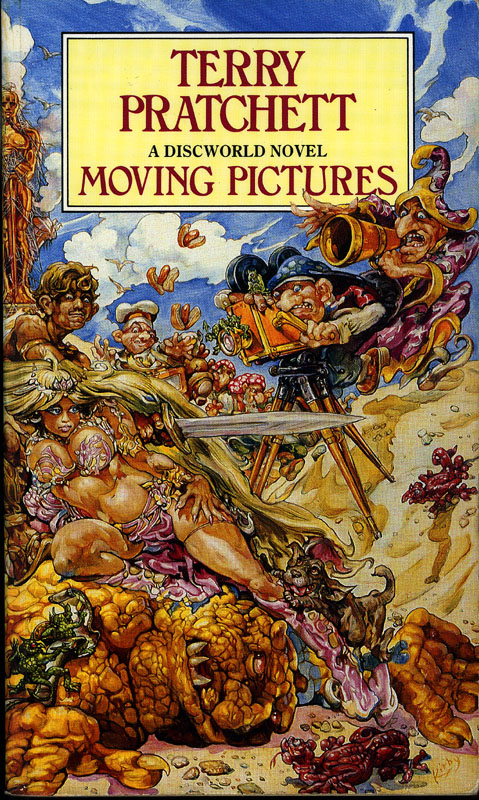
10. Moving Pictures
Pratchett’s most tried-and-tested formula is this: dump a modern concept or institution into his pseudo-medieval fantasy world and watch as the none-too-bright inhabitants take such a concept to its logical, ludicrous conclusion. Moving Pictures is one of the first Discworld books to go whole-hog with this idea, when a chance discovery at the Alchemists’ Guild, helped by the machinations of an ancient malign force bent on twisting reality out of shape, results in the invention of octo-cellulose – in short, the Movies. In true Discworld fashion, cameras don’t mess around with such mundane things as light-exposure, but rather they make dozens of tiny imps speed-paint everything they see, creating the first silent films. The early history of the movie industry is played out for laughs as hapless people from Ankh-Morpork, uncertain as to why they want to, flock to the dunes of Holy Wood hill to fulfil their dreams of becoming movie stars.
          As far as these books go, Moving Pictures is a fairly competent average in the series – not exactly one of the best or most memorable, but far is it from being a bad example. It tells a relatively good story, and it has fun doing so. The characters are decent, old faces from previous instalments showing up to fill new jobs in the budding movie industry, while the main roles are occupied by a few new, memorable faces. Victor Tugelbend, a perpetual student at the Unseen University, starts off memorable as a man who puts an inordinate amount of effort into living a care-free life, but alas his character gets a little watered-down as the plot trundles along. The supporting cast of Ginger, the prima donna of all of two months, and Gaspode the talking dog (or rather, talking street-mutt with fleas – the canine equivalent of Corporal Nobby Nobbs) give this book a little more to hold onto. It is Cut-Me-Own-Throat Dibbler, however, who steals the show – small-time street vendor and purveyor of unsanitary sausages first seen in Guards! Guards!, Dibber almost instantly manages to take over the movie studio with his panache for marketing, and his ability to make movies by designing the poster and tag-lines beforehand. C.M.O.T. Dibbler is one of Pratchett’s staple characters, popping up time and again throughout the series, and so to see him in this faintly villainous role is a rewarding and hilarious treat.
          But if there’s one thing that puts Moving Pictures in a most noteworthy spot in the series’ canon, then it’s because here we see the very first outing of some of the most wonderful characters Pratchett has to offer; the faculty of the Unseen University. The Dean, the Lecturer in Recent Runes, the Chair of Indefinite Studies, the Senior Wrangler, the Bursar, and not to forget the new and now permanent Archchancellor, Mustrum Ridcully; a group of elderly, overweight wizards who spend their time debating and bickering over the smallest, least-relevant  issues. In previous instalments, the wizards of the Unseen University went through several bloody changes of leadership, and I like to imagine that by this stage it is simply the most useless, bumbling individuals who have been left standing. Whatever the case may be, these blokes are here to stay, and their incredible tangents and side-plots to the main story will result in some of the most entertaining scenarios Pratchett has ever written, and I look forward to experiencing it all over again. Moving Pictures is good, and if you’re a fan of the wizards then it’s an absolute must.

11. Reaper Man
Death is one of the most original characters in this series. I say this in full knowledge that he is quite unambiguously lifted from medieval folk tales and art, has been used time and again in stories, music and film. He is a near God-like entity, often referred to by his title the ‘grim reaper’, but something that Pratchett has done to him is to give this all-so-familiar character a personality and depth that far outweighs many other literary creations. Death is no mere parody. He is the sort of being who would exist in a more perfect world.
In this book we witness the arrival of a group of villains who seem to be the very antithesis of what the Discworld is all about. The Auditors of Reality, faceless grey-robed celestial beings who lack all notion of a separate identity, and who despise all life, all creativity, all personality, as chaotic and unorganised, ruining the perfect order and tidiness of the universe. Naturally, they really hate the Discworld and its inhabitants. Having noticed that Death has developed something of a personality, something of a sense of interest and compassion to the living beings of the Disc, the Auditors contrive to have Death dismissed – making him mortal, and banishing him to the Disc. As one who has spent eternity as a reaper, Death signs on at a farm and attempts to spend his newly-granted ‘time’ as best he can.
But without Death, the Discworld quickly falls into chaos. The faculty of the Unseen University quickly find this out, when their esteemed 130 year-old colleague Windle Poons gets up after his own demise, and refuses to act like a respectable corpse ought to. Windle Poons, after obligingly allowing the faculty to bury him under the busiest street in Ankh-Morpork, sets off to find a purpose in his newly found un-death, while the remaining wizards try their best to work out why random objects are moving of their own accord, why there are hundreds of little snow-globes popping into existence in dark spaces, and why there’s now a serious infestation of trolleys zooming around the city and causing havoc.  
Reaper Man is one of the best books in the series. The rather odd and sombre moments of Death filling his new role as a reaper are juxtaposed with the second outing of Archchancellor Ridcully and his faculty of wizards, who are without doubt the most brilliant group of characters ever to be found in a novel. These old men bicker over the smallest and least-relevant issues at stake. The Bursar is gradually losing his mind thanks to the Archchancellor, the Archchancellor’s swear-words are turning into bug-like flying creatures while the Dean, upon discovering that he is allowed to blow things up, gets quite carried away with excitement and can’t pass up an opportunity to say ‘Yo!’ in every sentence.  They crack me up every time, and it’s never a dull moment when they’re around. So yes, this is a pretty good instalment in the series, so definitely add it to your collection if you get the chance.

12. Witches Abroad
The third instalment of Granny Weatherwax’s sub-series, or the second since she acquired her fellow witches as co-stars. Magrat, the youngest and most naive of the three witches, has inherited the role of a fairy God-mother to a princess in the far away fairy-tale kingdom of Genua. Along with Granny Weatherwax and Nanny Ogg, the three witches leave their home of Lancre and journey across the Disc, where they aim to sort out all of the sinister fairy-tale occurrences that have been going on lately, by confronting the ‘Good’ fairy God-mother Lilith who will resort to any evil in order to bring about a ‘Happily Ever After’ style ending.
          Another middling Discworld book, this one has the same subject-matter and targets of humour as Wyrd Sisters, poking fun at fairy tales in general but also subverting the genre, asking questions such as whether the princess really does want to marry the prince, or even should she. There are some potent moments of storytelling here, times when the story gets a tad dark and gripping as it builds up to a rather tense climax. The trade-mark Pratchett humour is working very well underneath this all, and the notion of Greebo (Nanny Ogg’s evil cat) being granted human form provides many of the most entertaining sequences near the end of the book. Along with this, we get decent chemistry within the witch-group themselves, when Granny and Magrat argue and bicker, Nanny Ogg in the middle, providing good character-development for what had already been three well-constructed protagonists.
          This particular part of the series you would be better off reading if you had already met the witches before. It’s not one of the absolute strongest Discworlds, but it works well enough and is entertaining to say the least.

A few concluding remarks. The best book this time around was Reaper Man, winning hands-down. Death is clearly the iconic character of the series, and to have him juxtaposed with Ridcully and the wizards has yielded some spectacular results. Moving Pictures is another good thing to read, while fans of Rincewind will find Eric indispensible. Lastly, Witches Abroad gives us once again the great characters of the witches, while demonstrating Pratchett’s growing devotion to the idea of individual character-sagas. All in all, each one is good, and if you have a sense of humour and a soul then you find something worthwhile here. I cannot recommend the Discworld series highly enough. Rest in peace, Sir Terry.

Biblioworld 3
Pratchett, Terry. Eric. Victor Gallancz/Corgi. (1991 [First Published 1990])
Pratchett, Terry. Moving Pictures. Corgi. (1991 [First Published 1990])
Pratchett, Terry. Reaper Man. Corgi. (1992 [First Published 1991])
Pratchett, Terry. Witches Abroad. Corgi. (1992 [First Published 1991])

Tuesday, 21 April 2015

Stormbreaker, and the Alex Rider series, by Anthony Horowitz


‘Every bored schoolboy’s fantasy, only a thousand times funnier, slicker and more exciting... genius.’ – The Independent on Sunday
‘Horowitz will grip you with suspense, daring and cheek – and that’s just the first page! ... prepare for action scenes as fast as a movie.’ – The Times

These are the taglines printed on the cover of the book. They’re heaping praise and lavish recommendation on this book, overflowing in their efforts to get you to read and love them. In some ways these words are accurate, but in one respect they’re sorely misleading; whether the books are actually good or not.

The synopsis and plot of this series is rather simple; almost patronisingly so. Alex Rider is a 14 year-old teenager from London (wherever the hell that is), who wakes up one day to find that his only living relative, his uncle Ian Rider, has died. What’s more, it turns out that Uncle Ian was actually a spy working for MI6, and that his death was no accident. He was murdered whilst on a mission! Alex ends up being drafted into MI6 and sent to complete the job that his uncle started. After uncovering the sinister and, dare I say it, quite childish villain’s scheme in Stormbreaker, Alex then has eight or nine more novels to fill with other dubious stories of teenage espionage, with the deliberately hanging plot-thread of facing his uncle’s killer to try and keep us reading through the whole series. I managed until as far as book three before I packed it in.

In particular, one aspect leapt out at me from these recommendations. It is the notion of ‘slick writing’ and the ‘action scenes as fast as a movie’. This straight away struck a negative chord within me – that in order to advertise these novels, reviewers feel that they have to compare them to films. Maybe it was just a feeling of turn-of-the-century cynicism that marketers, imagining that the only thing that would appeal to Generation-Y youngsters was some form of screen-based entertainment, and that the only way to make them even consider reading a book was to say “Hey it’s all right kids! This is basically a movie!”, but I myself would consider it immensely patronising. Nobody needs to be told that this thing is almost as good as something completely different. A good film is a good film, and a good book is a good book. A good film cannot really be described as any better than a good book, and vice versa.

Comparisons with Harry Potter are unavoidable. Here you have two Young Adult British literary heroes of the turn of the century, icons for readers of its age-range. Though the Harry Potter series has substance, pacing, excellently written characters, admirable morals and even, I would say, something approaching an engagement with reality, all Alex Rider has is a desire to be a movie; the writing is brief, almost anorexic in its layout. Maybe you’re happy with this from the printed word, but I can’t help but feel that this is merely the literary equivalent of a branded cereal-bar; small, unsatisfying, and ultimately forgettable beyond the range of “Oh yeah, I had one earlier today.” Maybe I’m being a bit harsh; I mean, don’t let my negativity mislead you – it has certainly got a sense of style. It gets the story and the drama across. But, to use a cliché (something Horowitz has been known to do from time to time), Alex Rider is very much ‘style over substance’. Like Alistair MacLean, only with more trainers and sports bicycles.

Many of the characters are actually nothing more than sly summaries, a witty little phrase written to give the illusion of there being something more there. And those are the good characters. One of them, Jack Starbright, is set up to be a lot more important a character than she actually is – a girl with a masculine name, an American student or something who became Ian Rider’s house-keeper, and is now essentially Alex’s guardian and sole friend; or at least would be if she had anything more to do in these novels than be mentioned a couple of times in passing. In effect she’s nothing more than a plot device, something that Alex Rider’s bosses in MI6 can blackmail him with should he not co-operate with them. Deport her back to the USA and send him to an orphanage, that sort of thing. She could have been utilised for some necessary character development for Alex or something, but that was quite obviously too boring for a series of action novels for teenage boys, and so she’s left to gather dust.

Now then, Alex Rider himself.
He rolled out of bed and walked over to the open window, his bare feet pressing against the carpet pile. The moonlight spilled onto his chest and shoulders. Alex was fourteen, already well-built, with the body of an athlete. His hair, cut short apart from two thick strands hanging over his forehead, was fair. His eyes were brown and serious.” [Stormbreaker. Pp. 7-8]
          Don’t you hate him already? It could have almost worked as an introduction, apart from those little ‘serious’ brown eyes of his. We’re told that Alex is a serious character, and occasionally he broods over his lot in life for a sentence or two before the next hair-raising action scene. He gets snarky at people if they take umbrage with him, and he gets a couple of gadgets doled out to him every book – 21st century middle-class white-kid toys that have one or two nifty features built into them, which are bound to come in handy at just the right time. We get a fair amount of product-placement here as well; never an end to those things that teenagers love, like Game Boys, Michael Owen, and Coke.

          The stories are all basic, hum-drum. Stormbreaker involves Alex sneaking around a rich-man’s villa to work out why he’s giving a bunch of free computers to every school in the country; answer, they’re filled with poison-gas or radioactive something-or-others which will wipe out every last one of the UK’s kids, because the villain was bullied at school. Yep, that’s the reason behind the plot. Point Blanc has Alex posing as a rambunctious rich-kid sent to an exclusive school high in the Alps, to find out what its founder, Dr Grief, is doing to them. It seems he’s cloning them and having his mind placed inside each and every one of these kids, so he can get himself into privileged positions of power around the globe and therefore take-over-the-world! Oh yes, and he’s a massive racist from South Africa who was annoyed when Apartheid ended, just in case you didn’t realise he wasn’t a very nice man. And lastly, because I don’t really care to read any more of them, Skeleton Key has Alex snuck under-cover into a mini-Cuba with a couple of CIA agents, to investigate a retired Soviet general who for some reason has gotten his hands on an atomic bomb.

          There’s nothing more to it than that. The Alex Rider series is a bunch of fast-paced YA novels about an unwilling teenage spy – or superspy, as the marketers thought to style him; I don’t know why, as there doesn’t seem to be anything that super about him. Easy to read, but instantly forgettable; if you’re twelve, then you might like it. Or read Harry Potter instead, a series that actually has a story, good characters, and depth (reviewed September 2014, if you want reasons for why Rowling is good). Horowitz has achieved some degree of success as a writer, so clearly he knows his market. I just think younger readers deserve something a tad more worthwhile than this.

Bibliobreaker
Horowitz, Anthony. Stormbreaker. Walker Books. (2000)
Horowitz, Anthony. Point Blanc. Walker Books. (2001)
Horowitz, Anthony. Skeleton Key. Walker Books. (2002)

Tuesday, 31 March 2015

Good Omens, by Terry Pratchett and Neil Gaiman


A few weeks ago Terry Pratchett most sadly passed away, momentarily leaving the world a darker place. His writings have been an integral part of my life since childhood, and when I learned to read for pleasure I would always come back to a Discworld novel for good cheer, entertainment, and a little depth. Pratchett has left behind a substantial corpus of literature, and it brings me comfort that at just eight books into writing a review of the entire Discworld series (books 5 to 8 reviewed this January!), I still have a long way to go before the end. This does however present a moment to take a diversion from Pratchett’s flagship series, and to review one of this man’s other most well-known projects; his collaboration with Neil Gaiman, the well-meaning apocalypse Good Omens. Yet this is a book review, not a eulogy, and so I can’t be expected to give this book a clean bill of health should it deserve none; thus if you want a loving tribute to this most worthy writer, then you ought to look elsewhere. Or better yet, wait for a few weeks until I re-read Reaper Man, by which point I expect to be crying my eyes out (with laughter, hopefully, as well as sorrow).

          Good Omens, then. The plot is essentially just a mish-mash of 1976s’ The Omen with a few other bits of late 20th century blockbusters thrown in for good measure. The demon Crowley is tasked with smuggling a new-born infant, no less than the Antichrist, into the care of a ‘suitable’ human family, with the understanding that after eleven years it will bring about the end of the world. Crowley makes a mistake, and instead of the intended family – that of an American diplomat in the UK – the child instead ends up in the custody of a completely normal couple from the local village. Eleven years go by before Crowley realises his mistake, and when it is finally made known to him he asks help from the only person he can trust; his opposite number from Heaven, the Angel Aziraphale – and so, neither of them wanting the world to end, with the storm-clouds of the imminent Armageddon gathering overhead they set out to locate and kill the Antichrist (an eleven year old boy living a care-free life who loves nothing more than spending time with his friends and playing with his dog). Also sucked into this tangled plot are the Four Horseman of the Apocalypse (small-time dealers of death and chaos on their own, reunited for the big finish each with their colour-coded motorcycles), a young witch who possesses the only truly accurate book of prophecies ever written, the last two members of the once vast Witchfinder Army, and a cut-price Medium who lives next door.

          While the two writers are just about able to keep all of these diffused plot-elements held together, all-in-all it feels just a little hotchpotch. At first the various characters are able to maintain distinct personalities, but as the end looms nearer – and the scale of what the writers are trying to achieve becomes apparent – it’s evident that the book is struggling to deliver on all of its promises. The plot meanders around in the early chapters, but by the end it feels as if the whole thing is contriving itself just to try and tie up all the various loose threads. I hate to say this, but I genuinely think that Pratchett and Gaiman overreached themselves here, and it just comes across as underwhelming, what with all the numerous characters getting lost in this vast field and artificially jostling around for the reader’s attention. The final confrontations – because there seem to be at least three separate ones which take place one after another, watering down any dramatic effect they may have had – seem like cardboard cut-outs half-heartedly putting on a Punch-and-Judy show, almost as though the book is trying to get all the excitement across that it promised with as little effort as it can get away with.

          But how does it stack up in the comedy department? Here and there it proves amusing, but it doesn’t really compare to any of Pratchett’s finest works. In places you can definitely recognise the style, and I quite like the running gag about secret agents and ducks:
          The ducks in St James’s Park are so used to being fed bread by secret agents meeting clandestinely that they have developed their own Pavlovian reaction. Put a St James’s Park duck in a laboratory cage and show it a picture of two men – one usually wearing a coat with a fur collar, the other something sombre with a scarf – and it’ll look up expectantly. The Russian cultural attaché’s black bread is particularly sought after by the more discerning duck, while the head of MI9’s soggy Hovis with Marmite is relished by the connoisseurs.’
          [Corgi edition, pg. 46]
And later on, in a section that brings joy to my heart:
          St. James’s Park was comparatively quiet. The ducks, who were experts in realpolitik as seen from the bread end, put it down to a decrease in world tension.’
[Corgi edition, pg. 372]

          So yes, there are odd little jibes at modern Britain, a few pokes at film clichés and one or two half-decent characters floating around in this broth of a book to prompt a chuckle, but alas it’s far from the best comedy novel to ever appear. It goes on a bit too long to be justified by the, at best, variable level of quality seen in the writing, and the watering-down effect of the characters and the amount of contrived story do not weigh in its favour. It won’t hurt you to read it, but at the same time it’s not particularly worthwhile to pursue. Maybe it’s the fault of co-authorship. Pratchett and Gaiman are both excellent writers in their own fields, but this collaboration doesn’t exactly measure up.  

In the end, co-authorship of a novel is probably a bad idea for anyone, no matter how good each writer is. Any truly worthwhile book is the result of the vision and ability on one particular individual, who imbues it with a sense of their own personality, so that while two writers can apparently share the burden of producing a novel, the end result is bound to be watered down, confused and a bit haphazard. But then, what do I know about such things?
What do you think?

Bibliomens
Pratchett, Terry and Gaiman, Neil. Good Omens. Corgi. (1991 [First Published 1990])